
Author: Patrick

  • 💨 Diatomaceous Earth vs. Essential Oils 🌿 Which is Better Against Bugs?

    💨 Diatomaceous Earth vs. Essential Oils 🌿 Which is Better Against Bugs?


    DE vs. Essential Oils: Which Natural Spray Actually Kills Bed Bugs and Ants?

    When seeking a natural pest solution, most homeowners land on one of two popular alternatives: messy Diatomaceous Earth (DE) powder or easy-to-use essential oil sprays. While both options avoid harsh chemicals, the results—and the experience—can be vastly different.

    This guide breaks down the true efficacy of essential oils, the persistent problems of DE powder, and introduces the one natural spray that delivers powerful, reliable knockdown without the chemical or aromatic drawbacks.


    Essential Oils: The Good, The Bad, and The Overpowering Smell

    Essential oils (such as peppermint, cedarwood, or clove) have become popular due to their pleasant scents and perceived safety.

    • The Attraction (Scent): Oils can repel certain pests and offer a nice aroma, making the application process bearable for the user.
    • The Failure (Efficacy): The primary drawback is that essential oils rarely provide reliable, quick, or residual killing power against major infestations like bed bugs and ants. They are often repellents, not killers. Pests frequently walk right through them once the scent dissipates.
    • The User Problem: While you might like the scent of peppermint, your pets might be agitated by the strong aroma, and continuous application can leave a lasting, overpowering natural oil scent in your home, leading to user and pet discomfort. You want a product that is lethal to bugs, not irritating to you.
    Essential Oils: The Good, The Bad, and The Overpowering Smell

    🌿 Common Essential Oils Used in Pest Control Sprays

    Essential oil pest control sprays often rely on one or a blend of the following botanicals for their strong scent and rumored repellent properties. However, remember these aromas can often be overpowering for people and pets, and lack the immediate killing power of BLITZ.

    • Mint/Herbals: Peppermint, Rosemary, Basil
    • Citrus/Grassy: Citronella oil, Lemongrass
    • Medicinal/Woody: Tea tree oil, Eucalyptus oil, Cedarwood oil
    • Floral: Lavender oil
    YouTube player

    The DE Powder Problem: Why the Old Solution Is Still a Mess

    We’ve all seen the videos: a small pile of white powder dusted across the entry point. The mechanism of DE is proven, but it is not a perfect solution for modern homes.

    • The Inhalation Hazard: Powder inevitably becomes airborne, creating an inhalation risk for your family and clogging up your environment.
    • The Wait Time: Powder is slow-acting. It requires the pest to fully coat itself and then wait hours or days to desiccate.
    • The Mess: Cleanup is difficult, requiring specialized vacuums and leaving chalky residue.

    If you want a detailed breakdown of the hazards and drawbacks of DE, read our complete guide to Diatomaceous Earth here.

    The BLITZ Difference: Maximum Power in an Unscented Spray

    BLITZ was engineered to eliminate the drawbacks of both DE powder and essential oil sprays, delivering superior, non-toxic results:

    • Immediate Stopping Power: Unlike essential oils that just repel, BLITZ uses a micronized liquid suspension of the same mineral that makes DE effective. This formula works on contact, causing immediate disorientation and rapid desiccation—providing the knockdown power you need right now.
    • No Overpowering Scents: Our formula is unscented, water-based, and non-staining. You get zero aromatic residue, meaning comfort for your family and pets while maintaining an invisible, lethal barrier for pests.
    • Residual Prevention: The spray dries into an invisible, powerful residual barrier that lasts long after application, giving you the immediate kill and the long-term prevention that simple essential oil sprays lack.

    Final Verdict: When You Need More Than Just a Scent

    If you need a natural solution that is odorless, easy to clean, and provides rapid knockdown and lasting prevention, your choice is clear. Don’t settle for overpowering scents or messy powder.

    We hope this makes sense, but we hope it doesn’t make scents.

    Upgrade Your Defense: Shop DE! BLITZ Now

  • Are 🧂Borax and Baking Soda❄️ Truly Safe for Pest Control?

    Are 🧂Borax and Baking Soda❄️ Truly Safe for Pest Control?

    Borax, Baking Soda, and More: Are Household Cleaners a Safe Option for Pest Control?

    When faced with a pest problem, many homeowners immediately turn to common household products like Borax, baking soda, or even vinegar. These natural remedies are cheap and accessible, but are they safe, and—more importantly—are they effective?

    This guide dives into the science of popular home remedies and compares their questionable results against the proven dangers of professional chemical sprays. We will show you the smarter, safer solution that offers maximum efficacy without the trade-offs.


    The Risks of Home Remedies: Borax and Baking Soda

    YouTube player

    Home remedies can be a dangerous gamble. While baking soda is generally harmless, Borax presents several significant risks, especially when misused for pest control:

    • Toxicity: Borax (sodium borate) is toxic if ingested. When applied as a powder for ant control, it creates the same inhalation hazard as DE, but with chemical toxicity risks.
    • Misapplication: Applying these powders requires precise placement, often near baseboards or food areas. If pets or children are exposed to the powder (by sniffing, licking, or tracking it through the house), it can lead to health issues.
    • Inconsistent Results: The effectiveness of these remedies is highly unreliable. Pests must consume them or be exposed in specific ways that are difficult to control in a household environment.

    As a common DIY example using borax and baking soda, some people may attempt to mix borax with sugar and water to create an insect lure/bait. While this may be effective to a degree, it’s an immediate danger to any household pets that may be tempted to try the sugar water/borax mixture too.

    The True Danger: Comparing Home Remedies to Chemical Poisons

    Comparing Home Remedies to Chemical Poisons

    The biggest threat to household safety is not usually the home remedy, but the harsh, neurotoxic chemicals found in many common professional and over-the-counter pest sprays.

    • Common Chemicals: Major professional-grade and retail pesticides (like those sold by Raid, Target, etc.) often contain chemicals such as Pyrethrins or Permethrin. These are neurotoxins designed to disable the insect’s central nervous system—and they come with serious warnings for humans and pets.
    • The Exposure Problem: Misapplication or overspray of these chemicals can result in acute symptoms (headache, dizziness, nausea) and long-term health concerns, leading many homeowners to avoid them entirely.

    There is a massive gap between unproven home remedies and dangerous chemical poisons.

    The Safer Professional Solution: Powerful and Non-Toxic

    BLITZ was engineered to fill that exact safety gap. It is the definitive solution for homeowners who refuse to use harsh chemicals but demand professional-grade killing power.

    • Guaranteed Safer: While we utilize the power of DE, our formula is designed to be safer than common chemicals and active ingredients found in competing retail products. You get the peace of mind of a non-toxic, water-based solution.
    • Effective on Contact: You don’t have to wait for pests to consume a powder, and you don’t have to rely on a weak repellent oil. BLITZ kills on contact via desiccation, providing immediate control where you need it most.
    • No Particulates: Because it is a spray, you eliminate the risk of tracking chemicals or powders across your home, protecting your children and pets from accidental exposure.

    Knowledge is Your Best Defense

    Knowing the risks of both extremes—unreliable home remedies and dangerous neurotoxins—allows you to choose a product that protects your family while eliminating pests quickly.

    Click here to read our full guide on the hazards of powder-based solutions like Borax and Diatomaceous Earth.

    Ready for a solution that’s safe AND effective? Pick up DE! BLITZ Now!

  • The Secret to Long-Lasting Natural Pest Control 💪

    The Secret to Long-Lasting Natural Pest Control 💪

    The Secret to Long-Lasting Natural Pest Control (Beyond Messy Powder & Volatile Chemical Compounds)

    When you treat a pest problem, you want two things: for the pests to die immediately, and for them never to come back. The problem is that most “natural” solutions—from essential oils to traditional Diatomaceous Earth—fail at the long-lasting prevention part. They either dissipate quickly or get wiped away instantly.

    This guide reveals the key difference between temporary fixes and durable protection. We look at the pitfalls of powder and why a modern, non-toxic formula is the secret to creating a powerful, long-term defense.


    The Frustration of Powder: High Effort, High Mess

    Traditional DE requires significant effort to apply correctly, and the longevity of the application is constantly under threat:

    • The Airborne Hazard: Applying powder requires dusting, which inevitably creates a cloud of airborne particulates. This is hazardous and wastes product. Furthermore, if you accidentally dust too much, the pests simply walk around the large piles.
    • The Inevitable Cleanup: Powder is messy and difficult to clean. If it’s exposed, you have to vacuum it, risking damage to your appliance filters. The process of reapplying and cleaning up makes it a constant, dusty chore.
    • Zero Durability: Any small amount of moisture (a spilled drink, a damp mop, high humidity) immediately clumps the powder, rendering its killing power inert until it completely dries out again.

    Why Basic Bug Killer Sprays Fail to Last

    While liquids are easier to apply, many off-the-shelf natural sprays rely on simple water-based solutions that offer no long-term residual effect.

    • Once the liquid dries, the active ingredients are often washed away or dissipate, offering only a quick, localized kill.
    • The barrier vanishes, leaving your home unprotected days later.

    For a solution to truly provide long-lasting control, it needs to leave behind an invisible, durable, and effective shield.


    The Worst Residue: Understanding Chemical Longevity in Insecticides

    The Worst Residue: Understanding Chemical Longevity in Insecticides

    When focusing on long-lasting solutions, it is crucial to consider the kind of residue you are leaving behind. Most major pro-grade chemical pesticides (often found in popular brands like Raid or Target) rely on persistent neurotoxins to achieve a long-term kill.

    • Unwanted Chemical Persistence: These compounds—such as Imiprothrin and Cypermethrin—are synthetic chemicals specifically engineered to linger. Their toxic residue can remain active on floors, carpets, and baseboards for weeks. This creates an unwanted, lingering exposure risk for toddlers and pets who touch or lick the treated areas.
    • The BLITZ Difference: BLITZ was specifically designed to be safer than these common chemical ingredients. We achieve the same long-lasting residual barrier using a non-toxic, mineral-based formula, ensuring your defense is completely safe and effective over the long term.

    The BLITZ Solution: Durable, Invisible, and Long-Lasting Alternative to Harsh Pesticides

    BLITZ was engineered to eliminate the mess and fragility of powder while maximizing the residual killing power.

    • The Durable Barrier: Our unique formula suspends the active mineral in a water-based solution. When sprayed and dried, it creates an invisible, highly durable residual barrier that lasts long after application, unlike fragile powders or weak water sprays.
    • No Mess, No Fuss: Application is simple and targeted, and cleanup is a breeze—no dust is required, which makes your application easier to clean up and less likely to damage your belongings.
    • Consistent Kill: This durable residual shield means that any pest crossing the area weeks later still comes into contact with the formula and will be eliminated, providing superior, long-lasting prevention.

    A Cautionary Tale: The Global Risk of Pesticide Misuse

    YouTube player

    For many, the danger of toxic pesticides seems theoretical until it makes the news. However, there have been increasing reports globally of travelers checking into hotels and becoming severely ill—or worse—due to pesticide poisoning.

    • The Problem: These incidents often involve the illegal or careless use of highly concentrated, industrial-grade neurotoxins in hospitality settings, particularly in developing nations.
    • The Impact: The tragic harm to guests—who are unknowingly exposed to powerful residual chemicals lingering in rooms, air conditioners, or bedding—serves as a grave reminder that chemical persistence is not just a problem for pests, but a hazard for people.

    These extreme incidents underscore a vital principle: If a product is toxic enough to require strict safety warnings and ventilation when applied by a professional, it should not be the product you choose to use around your family at home. The safest product is one that relies on a non-toxic, mechanical kill method.

    Stop Treating—Start Defending

    If you’re tired of temporary fixes, messy dust, and reapplying chemicals, it’s time to choose a product that offers powerful, long-lasting defense in a clean, non-toxic format.

    If you still have questions about powder, see our full guide on the hazards of airborne Diatomaceous Earth.

    Achieve long-term defense with the ultimate solution. Get DE! BLITZ Now!


  • Treating Bed Bugs & Ants Without Harsh Chemicals 🚫

    Treating Bed Bugs & Ants Without Harsh Chemicals 🚫

    How to Pinpoint and Treat Ants & Bed Bugs Without Harsh Chemicals

    Finding bed bugs or ants in your home is stressful enough without the added worry of treating them with dangerous chemicals. If you have children, pets, or allergies, using common pesticides (like those containing known neurotoxins) is simply not an option.

    This guide provides simple steps for identifying an infestation and outlines the safer, non-toxic treatment protocol that delivers immediate knockdown and long-term prevention—all without ever exposing your home to harsh chemicals.


    Major retail and “professional-grade” pesticides often rely on neurotoxins to disrupt the nervous systems of insects. While effective, they introduce unnecessary risk into your living environment.

    Why You Should Avoid Common Chemical Pesticides and Industrial Insecticides

    YouTube player
    • Toxicity Trade-Off: Common ingredients in everyday sprays (often referred to generically as X, Y, and Z by toxicologists) come with severe handling warnings. These pose significant risks if ingested by a pet or child, or if inhaled during prolonged indoor application. BLITZ was formulated to be significantly safer than these common chemical ingredients, utilizing a mechanical kill method that is non-toxic to mammals.
    • The Smell Factor: Most chemical sprays leave a lingering, strong, chemical odor that makes your home feel unsafe and uncomfortable long after the pest is gone.

    First Steps: Identifying the Infestation

    First Steps: Identifying the Infestation

    Before you treat, you must confirm the source:

    • Ants: Look for the food source, entry points (small cracks in baseboards or foundations), and monitor the main trail.
    • Bed Bugs: Look for small, reddish-brown stains (fecal matter) on bedding, mattress seams, and behind headboards. Bed bugs hide in cracks and crevices closest to their food source (you).

    The BLITZ Treatment Method: Immediate Knockdown & Long-Term Prevention

    To safely treat an infestation and keep it from returning, you need a product that offers dual action: rapid kill and a lasting residual barrier.

    • Immediate Stopping Power: Unlike chemicals that require absorption or powders that require slow desiccation, the BLITZ formula causes instant disorientation and rapid kill on contact. This allows you to eliminate visible pests right away.
    • The Residual Barrier: Once the spray dries, it leaves behind an invisible, non-toxic residual barrier. Any pest that crosses this dried barrier in the days and weeks that follow will be killed, providing the long-term stopping and prevention that most natural sprays lack.
    • Targeted Application: The easy-to-use spray nozzle allows for safe, targeted application into cracks, seams, and behind furniture—the exact places pests hide—without creating a hazardous cloud of dust or chemical mist.

    Don’t Let Invasive Insects Bug You

    You don’t have to choose between your family’s safety and an effective pest-free home. Choosing a non-toxic, targeted spray ensures your treatment is effective, immediate, and free from harsh chemicals.

    If you are considering using powder, click here to understand the serious inhalation hazards of Diatomaceous Earth before you apply it.

    Protect your family with the safer, non-toxic solution. Shop DE! BLITZ Now!


  • Your Winter Holiday Survival Guide: Keeping Bed Bugs Off Your Wish List

    Your Winter Holiday Survival Guide: Keeping Bed Bugs Off Your Wish List

    The most wonderful time of the year is here! The smell of cinnamon and pine is in the air, lights are twinkling, and the promise of a feast and good company fills our hearts. But amidst all the holiday cheer, there’s a Grinch-like pest that loves to ruin a good time: the bed bug.

    ‘Tis the Season for Welcome Guests- and Unexpected Pests

    These tiny, unwanted guests are the ultimate holiday party crashers. They don’t bring gifts or good tidings; they just want to hitch a ride on your luggage, hide in your festive decorations, and turn your peaceful home into their own winter wonderland.

    This holiday season, let’s keep them off the naughty list and out of your house for good!

    The Great Turkey Trot: Thanksgiving Travel & Guests

    YouTube player

    Thanksgiving is all about family, friends, and, for many of us, travel. Whether you’re flying home or hosting a house full of relatives, you’re creating a perfect storm for bed bugs to sneak in. They love to cozy up in luggage, jackets, and even the backpacks of little ones.

    • For the Travelers: When you arrive at your destination, do a quick “reconnaissance mission.” Inspect the mattress, bedding, and behind the headboard for any dark spots or tiny bugs. Keep your luggage on a luggage rack or in the bathroom, far away from the bed.
    • For the Hosts: After your guests depart, do a quick once-over of the guest room. Vacuum around the bed and other furniture, and wash all bedding on high heat. This simple step can stop a potential problem before it even begins.

    Deck the Halls, Not the Hives, this Christmas

    Santa Claus eyes his list during Christmas

    As you pull out those boxes of festive decorations, you might be unintentionally inviting bed bugs into your home. They can hide in storage, on second-hand ornaments, or even on the coats of visiting carolers!

    • The Ornament Inspection: Before you hang that heirloom ornament or string up the tinsel, give everything a quick check. If you’re using decorations that have been in storage for a while, consider giving them a wipe-down or a thorough shake outside.
    • A Word on Presents: Be mindful of gifts, especially those that are handmade or have been wrapped in a host’s home. It’s a small risk, but it’s always good to be vigilant. One person reported discovering bed bugs in a Christmas gift bag they received last year.

    Ringing in a Pest-Free New Year

    New Year’s Eve is a time for resolutions and fresh starts. What better way to begin the new year than with a home that’s completely free of unwanted pests? Let’s make a resolution to keep your space secure all year long.

    • The Post-Holiday Deep Clean: Once the decorations are down and the last of the holiday cookies are gone, take the time for a thorough deep clean. Vacuum every nook and cranny, and make sure to wash all bed linens and curtains on high heat. This is your final victory lap against any lingering holiday pests.

    The Ultimate Holiday Gift: Peace of Mind

    This holiday season, the best gift you can give yourself and your loved ones is a pest-free home. With all the traveling, hosting, and celebrating, it’s a mission that requires the right tools.

    When you’re ready to bring in the big guns, our BLITZ bed bug spray is your secret weapon. This bed bug treatment spray is designed to quickly and effectively eliminate any threats, ensuring your home remains a place of peace, love, and holiday cheer.

    Happy Holidays and a Pest-Free New Year to all!

  • Mission Briefing: Securing Your Military Barracks from Bed Bugs

    Mission Briefing: Securing Your Military Barracks from Bed Bugs

    This Veteran’s Day, we honor the brave men and women who have stood the watch, defended our nation, and protected our freedom. It’s a day to remember their service, their sacrifices, and the vigilant eye they keep on the perimeter.

    But what happens when the enemy isn’t on the battlefield but in your bedroom?

    All Hands on Deck: Enemy Bed Bug Threat Sighted

    Even the most hardened veterans know that an unexpected enemy can breach the lines. You might have heard the incredible story of the USS Connecticut SSN22, a powerful submarine that faced an entirely different kind of threat: bed bugs.

    YouTube player

    If these pests can infiltrate a submarine, they can certainly breach your ship or base barracks. That’s why we’re launching a new mission: to give you the tactical knowledge to keep your home front secure.

    In the War on Bed Bugs, This is Your Battle Plan

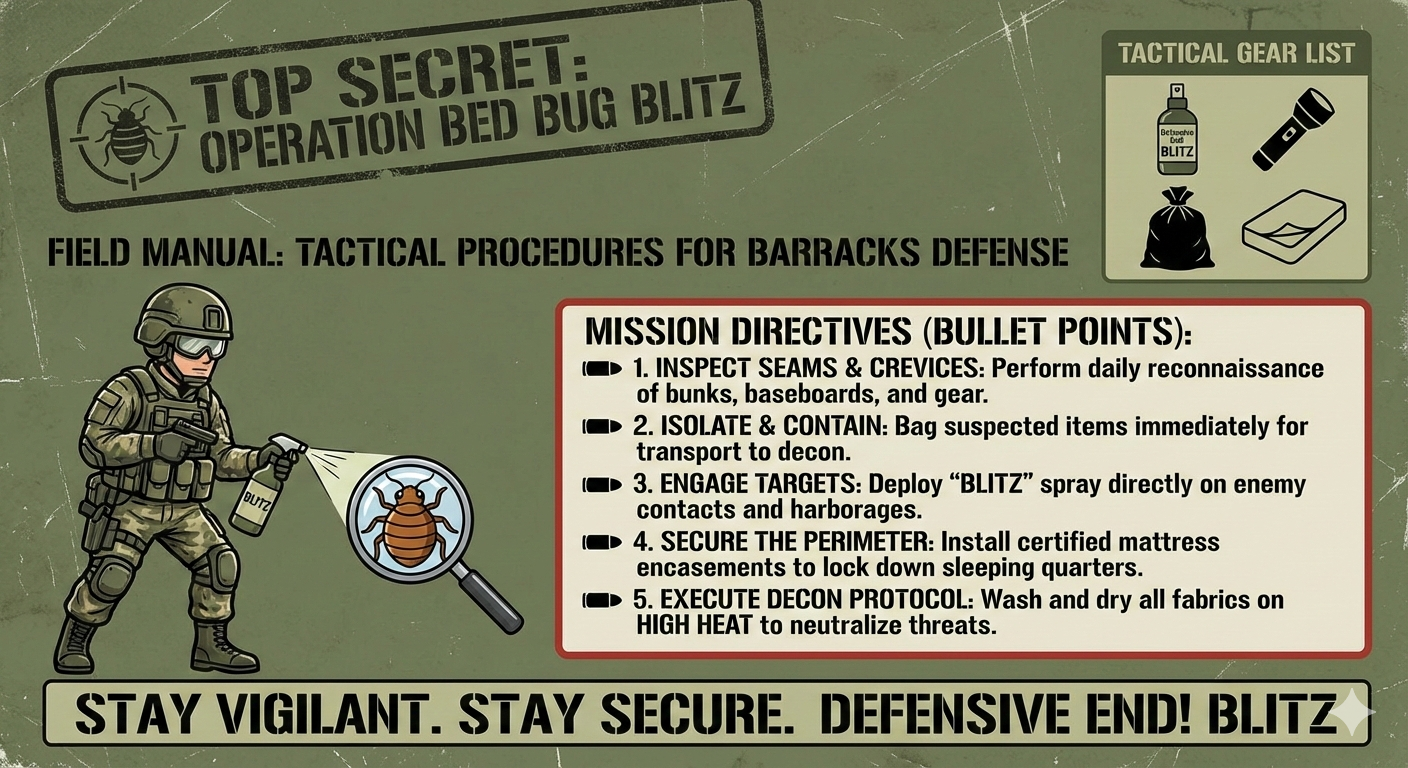
    Every successful mission starts with a solid plan. Bed bugs are tiny, stealthy infiltrators, but with the right strategy, you can win this war. Follow these key directives to lock down your defenses.

    Directive 1: Pre-Deployment Inspection

    The first step is a thorough reconnaissance. When you’re traveling or bringing new items into your unit in base housing, perform a detailed inspection of the building, including baseboards and wall plates in your bedroom.

    Next check mattresses, bedding, luggage, and furniture. Look for signs of the enemy: small, reddish-brown stains (blood) or tiny, dark spots (fecal matter). This early detection is your first line of defense.

    Directive 2: Secure the Perimeter, Soldier

    Just like securing a base, you need to make sure your sleeping area is a no-go zone for bed bugs. Encase your mattress and box spring in a certified, bite-proof cover. This traps any existing bed bug convoys inside and prevents new ones from taking up residency.

    Make sure to vacuum regularly, especially around the baseboards and corners of your room—these are prime hiding spots for the enemy.

    Directive 3: Decontamination Protocol

    sailors stand outside a ship in port

    When you return from a trip, consider everything you’ve brought back as potentially contaminated until proven otherwise. Wash all your clothes and travel bags in hot water and dry them on high heat.

    If you have non-washable items, a hot-air treatment in a dryer can neutralize any lurking threats. This decontamination process is crucial to preventing an outbreak.

    Mission Complete: Calling in Close Air Support

    With your battle plan in place, you’re ready to stand the watch. But sometimes, even the best-laid plans need a little extra firepower. When you’ve identified a threat and need to neutralize it, it’s time to call in the air support.

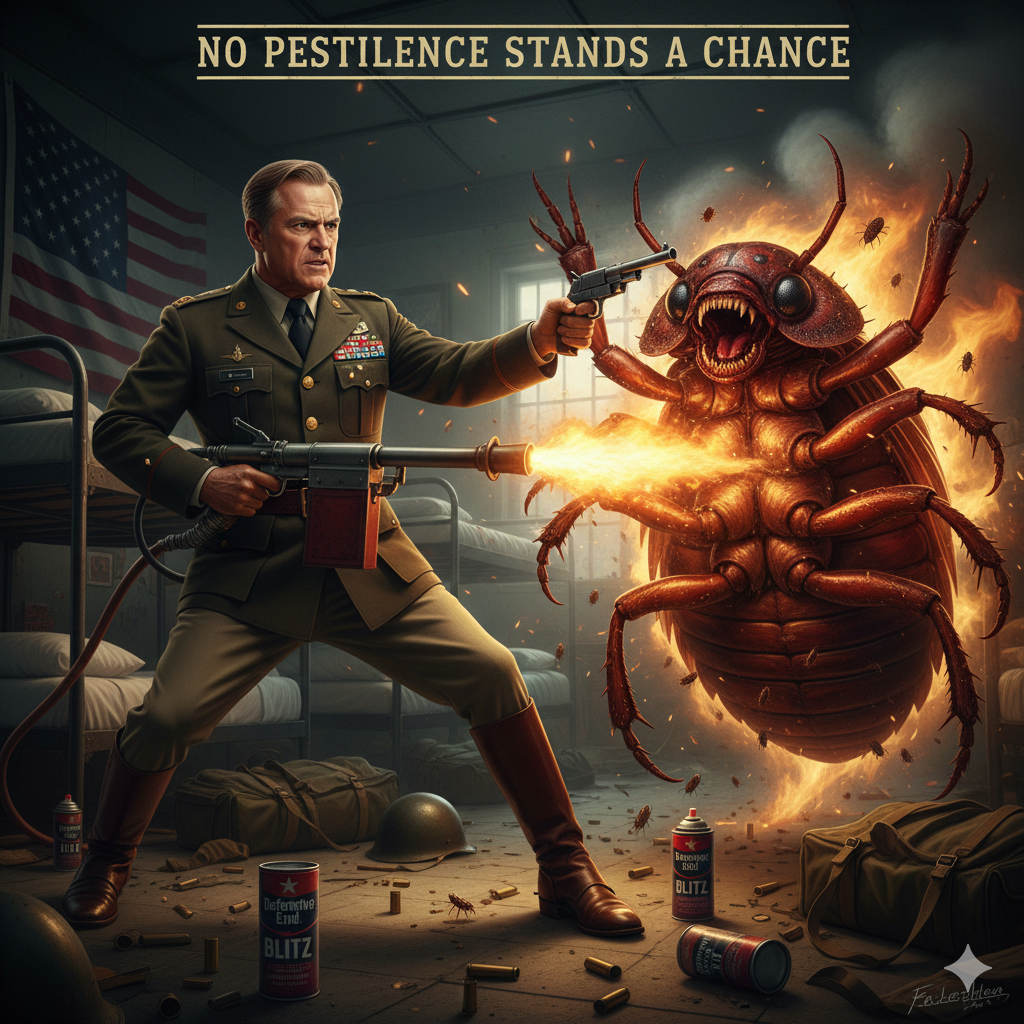
    Defensive End! BLITZ is your most powerful weapon in this fight. This bed bug contact and residual killer spray is specifically engineered to provide you with the tactical advantage you need. It’s a rapid-response solution designed to eliminate bed bugs and give you the peace of mind that your home barracks are safe and secure.

    This Veteran’s Day, we thank our veterans for their service. And we salute you for taking on the vital mission of protecting your home front. Stay vigilant, stay prepared, and let’s keep those barracks clear!

  • A Halloween Spook-tacular Guide to Bug-Free Trick or Treating

    A Halloween Spook-tacular Guide to Bug-Free Trick or Treating

    Halloween is here! The air is crisp, the pumpkins are carved, and the kids are buzzing with excitement for their costumes and candy.

    But while you’re focused on ghosts, goblins, and ghouls, there’s a real-life creepy crawly you need to look out for: the bed bug.

    Don’t Let Bug Bites Cause the Halloween Scaries

    Bed bugs are the ultimate party crashers. They’re masters of disguise, hitchhiking on everything from costumes to treat bags. But don’t let these uninvited guests ruin your holiday.

    As the defensive end for your family, you can run a masterful BLITZ on these pests and keep your home a bed bug-free zone.

    The Spooky Spaces: Where Pests Hide

    YouTube player

    Halloween and other fall festivities involve a lot of crowded, communal spaces where bed bugs love to lurk. Here’s where your defensive instincts need to be on high alert:

    • Costume Parties & Trunk-or-Treats: Kids are in close contact, and costumes get piled up. A bed bug can easily scurry from one jacket or cloak to another.
    • Pumpkin Patches & Hayrides: Hay and fabrics on hayride wagons can be perfect hiding spots for pests. If you bring a blanket for a hayride, it’s a prime target.
    • Haunted Houses: Upholstered furniture in waiting areas and the dark corners of a haunted house can harbor pests waiting for their next ride.
    • Trick-or-Treating: The very act of visiting multiple homes and interacting with other trick-or-treaters creates an opportunity for bed bugs to hop onto clothing, shoes, and especially trick-or-treat bags.
    • Car-Pooling: Since Halloween is often geared towards kids, parents who haul around their children’s friends may be shocked to find bedbugs from passengers riding in their car after they drop them off.

    Your Game Plan to “Ghost” Bed Bugs

    dog dressed up as a ghost for Halloween

    Just like you would with back-to-school season, a few simple defensive plays can make all the difference.

    1. The “Ghostly” Shake-Down: Before bringing any Halloween items inside, give them a good shake-down outdoors. This is especially important for fabric costumes, reusable trick-or-treat bags, and jackets worn to parties. A quick shake can dislodge any unwanted hitchhikers.
    2. The “Witch’s” Brew Wash: As soon as you can, toss all washable Halloween costumes, jackets, and fabrics into the washing machine. Wash them in the hottest water the fabric can handle and follow up with a high-heat dry cycle. High heat is the kryptonite for bed bugs and their eggs.
    3. The Final BLITZ: For items that can’t go in the wash—think plastic trick-or-treat buckets, costume accessories, or shoes—you need a different approach. That’s where BLITZ all-natural bed bug spray comes in. Our formula is your secret weapon, designed to target and kill pests on contact. A quick spray on the seams of shoes and the hard surfaces of costume props is your final line of defense against these creepy crawlies.

    Don’t let the fear of bed bugs steal the joy of Halloween. With a smart game plan and the right tools, you can ensure the only things haunting your home are good memories and leftover candy.

  • Four New Notorious Invasive Pests in the US and Why They’re Spreading

    Four New Notorious Invasive Pests in the US and Why They’re Spreading

    While most people are familiar with common household pests, a new class of threat is emerging: invasive species that can cause widespread damage to agriculture, wildlife, and even human health.

    These pests aren’t just a problem in faraway places—they’re appearing in our own backyards due to a perfect storm of climate change and global travel.

    Understanding these new threats can help you be more vigilant about all pests, from the uncommon to the common, like bed bugs.

    New Pest Outbreaks and Invasive Species in the US

    spotted lantern fly invasion of US

    1. The Spotted Lanternfly

    Originating in East Asia, the spotted lanternfly is a visually striking but devastating pest. It feeds on over 70 species of plants, including valuable crops like grapes, apples, and maple trees.

    The insect’s rapid spread is fueled by its ability to hitchhike on vehicles and cargo. As it feeds, it excretes a sugary substance called “honeydew” that promotes the growth of black sooty mold, which can kill plants and create a sticky, messy problem in yards and public spaces.

    2. The Asian Longhorned Tick

    First discovered in New Jersey in 2017, the Asian longhorned tick has now been confirmed in over 20 states, including Tennessee. This tick is a major concern because it can reproduce asexually, meaning a single female can lay up to 2,000 eggs without a male. This incredible reproductive ability allows it to establish huge populations very quickly on a single animal.

    While its primary host is livestock, causing severe blood loss and economic damage, it will also feed on pets, wildlife, and humans. It is now being studied to determine its potential role in transmitting diseases to humans in the U.S.

    New Notorious Invasive Pests in the US and Why They're Spreading

    3. The New World Screwworm

    Considered eradicated from the United States since the 1960s, the New World screwworm made a shocking return in a 2016 Florida outbreak. These are not typical maggots; screwworm larvae feed on the living flesh of warm-blooded animals, including livestock and wildlife.

    They lay their eggs in open wounds, and the resulting infestation can be fatal if left untreated. The resurgence of this pest, which was controlled for decades with a sterile insect technique, highlights how easily invasive species can re-enter and establish themselves in a new environment, especially with increased global travel and climate shifts.

    Fortunately, the USDA is not taking this threat lightly, recently moving to set up a new dedicated center in Texas to make a counter-assault against these pests and neutralize the threat.

    4. The Kissing Bug

    YouTube player

    Also known as the triatomine bug, the kissing bug is a nocturnal insect that has become a growing concern in the Southwest, particularly in states like Texas. It gets its name from its habit of biting people on the face, usually around the mouth, while they sleep.

    The real danger lies in the parasite it carries in its feces, which can transmit Chagas disease. While not everyone who is bitten will become infected, the disease can cause severe health complications years or even decades later.

    Cases have been confirmed in dogs and, more rarely, in humans in Texas, Louisiana, and other southern states.

    The Broader Lesson for Pest Management

    The rise of these pests demonstrates that no environment is safe from new threats. The common thread among these species is their resilience and ability to spread through human activity.

    Being educated about these issues is the first step in protecting your home and family, whether you’re dealing with a new invasive species or a classic pest like a bed bug. A proactive approach, including prevention and having effective solutions on hand, is always the best defense.

  • The Super Easy Guide to Sealing Your Home Against Insect Pests

    The Super Easy Guide to Sealing Your Home Against Insect Pests

    When it comes to pest control, the best offense is a great defense. You can apply all the sprays and traps you want, but if you don’t seal the entry points, new pests will just keep coming in.

    Pests, from the tiniest ants to larger rodents, are masters at finding their way inside through the smallest cracks and openings.

    By taking a proactive approach to sealing your home, you can create a strong, lasting barrier that makes it harder for unwanted guests to get in.

    How to Block Out Unwanted Insect Pests

    Why Pests Get Inside

    Pests don’t invade your home just to annoy you; they’re looking for three things: food, water, and shelter. A small crack in your foundation or a gap around a pipe is the equivalent of a welcome mat. The most common entry points are often overlooked because they’re out of sight.

    Common Entry Points:

    • Foundation Cracks: As your home settles, tiny cracks can form in the foundation. Insects like ants and termites can enter through these.
    • Gaps Around Pipes and Wires: Utility lines for water, gas, and electricity often leave small gaps where they enter the home. These are highways for mice, spiders, and roaches.
    • Torn Window and Door Screens: Even a small tear is a gaping hole for flies and mosquitoes.
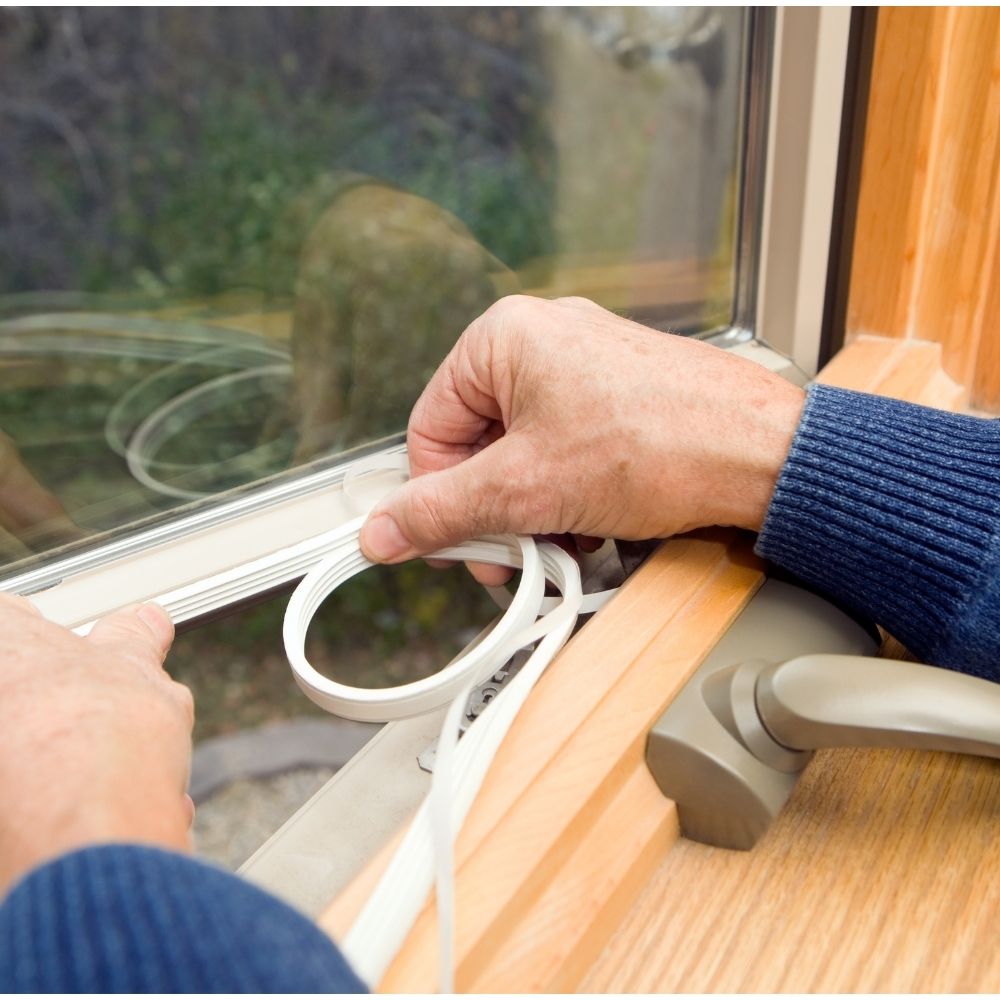
    • Damaged Weather Stripping: Old or damaged weather stripping around doors and windows creates an easy access point.
    • Vents and Chimneys: Unscreened vents and uncapped chimneys are open invitations for birds, squirrels, and wasps.
    how to seal cracks and crevices to prevent pests from entering your home

    Step-by-Step Pest Preventing Sealing Techniques

    Performing a thorough pest-proofing check of your home can be done with a few common tools and materials. Start with the exterior and work your way in.

    1. Inspect and Seal the Foundation: Walk around the entire perimeter of your home. Look for any cracks or holes in the concrete. Use a high-quality sealant or mortar to fill any gaps you find. For larger holes, you may need a patch or coarse steel wool, which rodents can’t chew through.

    2. Address Doors, Windows, and Siding: Check the weather stripping on all doors and windows, but don’t forget to insect-proof your siding (where applicable). If you can see light coming through any of the gaps, the stripping needs to be replaced. Use a good-quality caulk to seal any small gaps around the window and door frames. A door sweep on the bottom of all exterior doors is also a great idea.

    YouTube player

    3. Check Utilities and Vents: Look closely at where pipes, cables, and wires enter your home. Seal any gaps with a proper sealant or expanding foam, making sure to follow the product’s instructions for a secure fit. Ensure all vents leading outside have secure, fine mesh screens to prevent pests from entering.

    4. Repair Screens and Chimneys: Patch any tears in window or door screens, or consider replacing them if the damage is widespread. Make sure your chimney has a cap with a secure screen to keep out birds, raccoons, and other pests.

    5. Clean and Declutter: While not a sealing technique, keeping your home and yard clean and free of clutter removes a pest’s primary source of shelter. Remove piles of wood, leaves, and other debris from the area immediately surrounding your home’s foundation. Inside, store food in airtight containers and regularly clean up crumbs and spills.

    The Power of Prevention

    By taking the time to seal your home, you are doing more than just blocking pests. You are actively disrupting their ability to find safe harbor and resources. This proactive strategy reduces your reliance on chemical treatments and is the most effective long-term solution for a pest-free home.

    While sealing your home is the first and most important step, a comprehensive bed bug treatment and prevention guide is essential if you suspect an infestation has already begun. For a contact killer spray that works great on bed bugs, ants, and other crawling nuisances, check out our proprietary BLITZ bed bug spray.

  • The Playbook to Protect Your Kids from Lice and Mites this School Year

    The Playbook to Protect Your Kids from Lice and Mites this School Year

    The school bell is ringing, and kids are rushing back to class. But as you stock up on new notebooks and backpacks, there’s another kind of back-to-school preparation you need to make—one for the pests that might try to hitch a ride home.

    Stop a Back-to-School Pest Problem Before it Starts

    Think of yourself as the defensive end for your home. Your job is to spot the threats, execute a solid game plan, and tackle anything that tries to get past your line of defense.

    We’re talking about bed bugs, lice, and mites. Don’t worry, with a little preparation, you can keep your home a pest-free zone.

    Huddle Up: Know Your Opponents

    Before you can stop them, you need to know what you’re looking for. These pests are experts at staying out of sight, so a little reconnaissance goes a long way.

    • Lice: Head lice are tiny, wingless insects that live on the scalp. The most common sign is intense itching. While the adult lice are hard to spot, their eggs, called “nits,” are much easier to find. Nits are tiny, yellowish-white ovals glued to the hair shaft, often found behind the ears and at the nape of the neck. Unlike dandruff, they won’t flake off.
    • Mites: Mites like chiggers or scabies can also be a concern. Chiggers leave itchy, reddish welts, often where clothing is tight. Scabies mites burrow into the skin, causing an intensely itchy rash. If your child has a persistent, unexplained rash, it’s always a good idea to consult a doctor.
    • Bed Bugs: These aren’t just in beds. They are small, reddish-brown, oval-shaped insects about the size of an apple seed. They’re notorious hitchhikers and can cling to backpacks, clothes, bus seats, and lunchboxes. Look for tiny, dark spots (feces) on fabric, small blood stains, or a sweet, musty odor. The bites often appear as itchy, red welts in a line or cluster.

    Additionally, you cannot rely on your child’s school to proactively check all students’ heads for lice, since many school districts have moved to less aggressive forms of prevention and education.

    back to school parenting tips for lice and mites

    The Game Plan: Your Ultimate Defensive Strategy Against Lice, Mites, and Parasites

    Your best defense is a proactive approach. By building these habits into your back-to-school routine, you can intercept pests before they ever get inside.

    1. The “Drop-and-Roll”: As soon as your child gets home, have them remove their backpack and shoes. Don’t let them drop their stuff on the bedroom floor or on upholstered furniture. The best place for these items is in a dedicated spot like a mudroom or garage.
    2. Laundry Day Blitz: When clothes, jackets, and gym bags come home, wash and dry them on the highest heat the fabric allows. High heat is a powerful weapon against bed bugs and lice, killing them and their eggs.
    3. Daily Inspection: Take a minute each day to inspect your child’s backpack and lunchbox. Check the seams, zippers, and crevices for any signs of pests. A quick shake-out over a garbage can is an easy way to dislodge any unwelcome visitors. Take a comb or brush and carefully and slowly go through your child’s scalp, inspecting for tiny lice or small white specks that move.
    4. The Locker Room Huddle: Talk to your kids about not sharing hats, helmets, scarves, or other personal items with friends. Head-to-head contact is the primary way lice spread, and this simple chat can make a huge difference.

    Video: How to Treat and Prevent Head Lice

    YouTube player

    The BLITZ: Your Final Play

    Sometimes, despite your best efforts, you might get a warning signal—a suspicious spot, a series of itchy bites, or a notice from the school. This is when it’s time to BLITZ the problem directly.

    For non-washable items like backpacks, beds, or furniture, a direct defensive play is needed. That’s where Defensive End! BLITZ bed bug spray comes in. Our specialized formula is your go-to solution for targeting and neutralizing pests on contact, while leaving a residual barrier behind.

    elementary age kids enter a school building.jpg

    Apply it to the seams of beds, bed frames, backpacks, the insides of shoes, and other items that can’t go in the wash. It’s the final line of defense to ensure any unwelcome visitors are taken out before they have a chance to score.

    With a strong game plan and the right tools, you can play defensive end for your family and win the back-to-school battle against bed bugs, lice, and mites.