
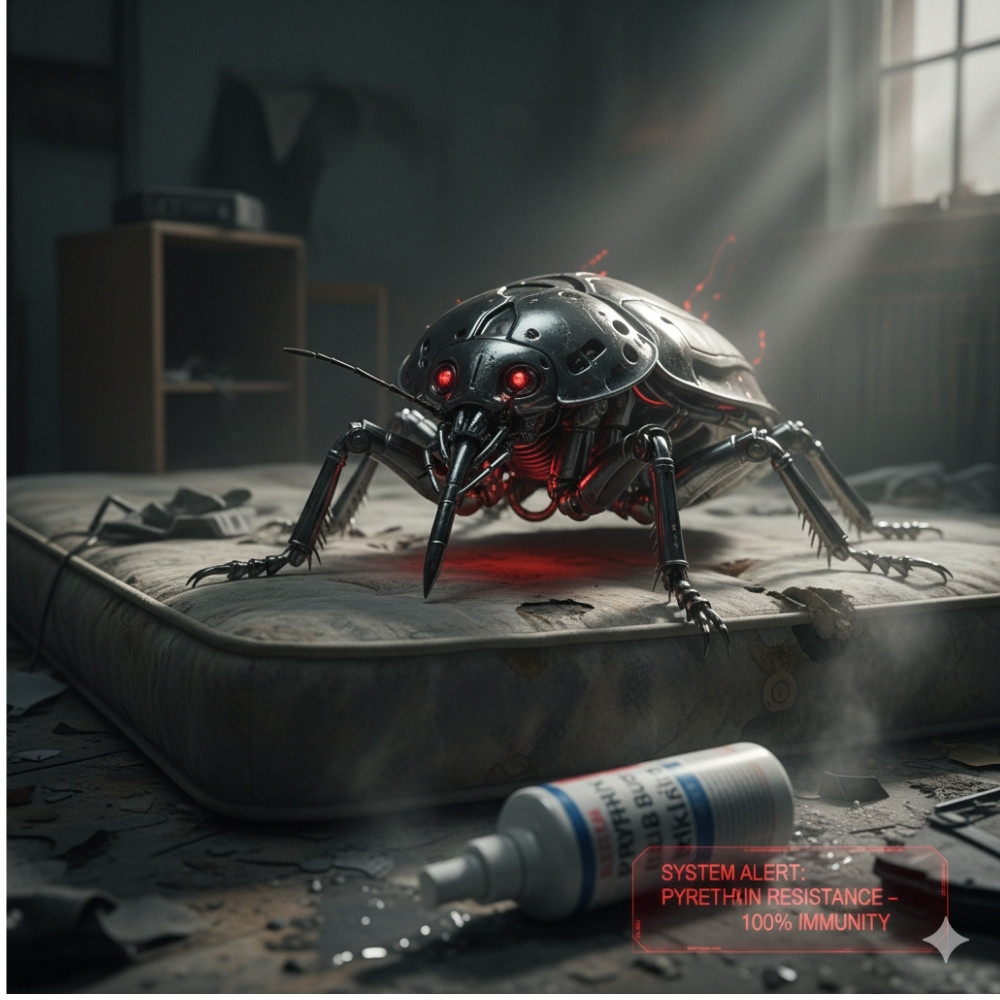
Pyrethrin-Resistant Bed Bugs are Getting Stronger
If you’re standing in a big-box store holding a bottle of “Bed Bug Killer” containing Pyrethrin or Deltamethrin, you aren’t holding a weapon. You’re holding a placebo.
Recent “battlefield” data from the Department of Entomology at Virginia Tech (2025) reveals a terrifying development: Bed bugs have developed a genetic mutation called the A302S Rdl gene.
This mutation allows their nervous systems to “shrug off” the very chemicals that used to be their biggest threat.
Intel Breakdown: The A302S Rdl Mutation

The primary reason store-bought pyrethrins are failing is a genetic “fortification” known as the A302S Rdl mutation. In layman’s terms, the bed bug has essentially rewired its own nervous system at a molecular level.
The Resistance Map: Where the Mutant X-Bug Population is Strongest
While the “Superbug” is nationwide, specific regions are showing nearly 100% immunity to pyrethroids:
- The Eastern Seaboard: Massive resistance spikes in New York, New Jersey, and Massachusetts.
- The South: High-level “knock-down resistance” (kdr) confirmed in Virginia (Suffolk/Norfolk areas) and North Carolina.
- The West Coast: California and Washington are reporting “Level IV” resistance where standard sprays fail to achieve even a 20% kill rate.
Why Your Once-Reliable Store-Bought Bug Spray is Now Failing
While older generations of bed bugs had “open ports” that allowed pyrethroid toxins to flood their systems and cause paralysis, the modern “Superbug” has swapped those ports for a reinforced version.
The chemical arrives at the target site, finds the door locked, and simply washes away, leaving the insect completely unharmed and ready to feed.
Tactical Data: Chemical Breakdown by Active Ingredient in Bug Spray
| Active Ingredient Type | Resistance Status (2026) | The “Why” |
| Pyrethrins | CRITICAL | Bugs have developed “thick skins” (cuticle thickening) and nervous system mutations. |
| Deltamethrin | CRITICAL | Field strains are surviving doses 55–2,000x stronger than laboratory bugs. |
| Fipronil | HIGH | New 2025 data shows mutations previously found only in cockroaches are now in bed bugs. |
| Defensive End! BLITZ | LOW | Uses a rapid-action physical and residual barrier that doesn’t rely on the “mutated” nervous pathways. |
Furthermore, this resistance isn’t just internal; it’s structural. Recent 2025 microscopy reveals that resistant strains are developing a significantly thicker cuticle (their outer shell).
This “dermal armor” slows down the absorption of traditional liquids, giving the bed bug’s internal enzymes—specifically cytochrome P450s—extra time to break down and detoxify the poison before it ever reaches a vital organ.
This is why “more is not better” when it comes to standard store-bought poisons. Drenching a room in pyrethroids only serves to kill off the weak, non-resistant bugs, effectively “clearing the deck” for the Superbugs to breed without competition.
SITREP: Check Your Labels – The “Do Not Use” List

Before you waste another dime at a big-box hardware store, you need to check the “Active Ingredients” on the back of your bottle. If you see any of the following chemicals, you are likely deploying 1990s technology against a 2026 “Superbug.”
In high-resistance zones like Norfolk, VA or San Diego, CA, these ingredients are essentially the biological equivalent of a “wet noodle.”
The “Ineffective” Chemical List
| Active Ingredient | Common Product Names | Why It Fails the Mission |
| Deltamethrin | Harris Bed Bug Killer, Suspend SC, DeltaDust | 2025 data shows field strains are immune to doses 5,000x the label rate. |
| Permethrin | Uniform Treatments, “Bug Bombs,” Foggers | Acts as a repellent; scatters the bugs into your electrical outlets instead of killing them. |
| Bifenthrin | Ortho Home Defense, Talstar | Excellent for ants; nearly zero “knockdown” power against modern A302S bed bugs. |
| Cypermethrin | Raid Max, Demon WP | Rapidly degraded by the bug’s internal detox enzymes (cytochrome P450s). |
The “Scattering” Hazard: Why Foggers Are FUBAR
If you see a “Total Release Fogger” (Bug Bomb) containing these chemicals, put it back on the shelf. Because these pyrethroids are irritants but not instant killers, they trigger a “flight” response in the colony. Instead of dying, the bugs will retreat deep into the wall voids, neighboring barracks rooms, or into your sea bag. You aren’t winning the war; you’re just spreading the front lines.
Tactical Advice: If your current spray smells like a chemistry lab and the bugs are still biting 48 hours later, you are dealing with Genetic Resistance. It’s time to stop the “friendly fire” on your own lungs and switch to a mechanical-kill solution like BLITZ.
The Permethrin Paradox
If you’ve ever been in the military, you know Permethrin.
It’s the synthetic pyrethroid fused into your ACUs/MCCUUs to stop ticks and mosquitoes. It works great for the “perimeter,” but when it comes to a bed bug breach in the barracks, Permethrin is effectively firing blanks.
1. Deterrence vs. Destruction Permethrin is primarily a repellent. For mosquitoes, it creates a “hot foot” effect that makes them fly away. Bed bugs, however, are highly motivated “hitchhikers.” Research shows they will often crawl right over Permethrin-treated fabric to reach a blood meal, especially if they carry the A302S Rdl mutation.
2. The “Genetic Shield” is Stronger Because Permethrin is in the same chemical family as Pyrethrin (Pyrethroids), the resistance is “cross-functional.” If a bed bug is resistant to the cheap spray from the hardware store, it is almost certainly resistant to Permethrin. In fact, laboratory tests have shown field-collected bed bugs surviving on Permethrin-treated cloth for days without dying.
3. The Risk of “Scattering” Using Permethrin-based “bug bombs” or sprays in a barracks room can actually make the mission harder. Because it’s a repellent, it doesn’t always kill the bug—it just pisses them off and drives them deeper into the wall lockers, electrical outlets, and neighboring rooms. This turns a single-room skirmish into a floor-wide invasion.
How to Overcome Permethrin-Resistant Super Bedbugs
To win this fight, you have to bypass the nervous system entirely.
Defensive End! BLITZ is engineered to ignore these genetic mutations, utilizing a rapid-response formula that compromises the pest’s physical integrity on contact and maintains a residual “no-man’s land” that even the most mutated A302S strain cannot bypass.
Bypassing the Acquired Resistance with an Effective Mechanical Penetration Solution and Residual Shield
| Feature | Standard Pyrethrin Sprays | Defensive End! BLITZ |
| Kill Method | Nervous System (Neurotoxin) | Rapid Contact + Long-term Residual |
| Resistance Level | Extremely High (Superbugs) | Extremely Low |
| Safety | Often contains synthetic PBOs | 100% Natural & Non-Toxic |
| Primary Use | General crawling insects | Specialized Bed Bug/Ant Neutralizer |
The “Thick Skin” Defense: Can They Resist DE?
This is also why diatomaceous earth has been used with relatively high effectiveness against bedbugs and ants, but even it’s not perfect.
While bed bugs can’t develop a chemical immunity to Diatomaceous Earth (DE) like they do with pyrethrins, they are developing a physiological tolerance.
- Cuticle Thickening: Research (including a notable study by Lilly et al.) has shown that highly resistant strains of bed bugs often have cuticles that are 15–25% thicker than non-resistant ones.
- The Healing Factor: A thicker cuticle doesn’t just make it harder for the DE to “score” a cut; it also gives the bug more “biological runway” to heal. Because DE is a slow killer (taking 7–14 days), a “thick-skinned” bug can often survive the initial abrasion long enough to reach a host, feed, and use that nutrient boost to repair its exoskeleton.
- The Speed Gap: In laboratory tests, the “Monheim” (weak) strains die quickly from DE. But the “Haplotype B” (Superbugs) are often seen literally walking through DE like it’s nothing.
From our observations and testing, a combination of different effective attack vectors gives you the highest odds of defeating all bedbugs in any given infestation. BLITZ contains 2 powerful, natural active ingredients that provide effective desiccation, dehydration, and cuticle penetration by different means.